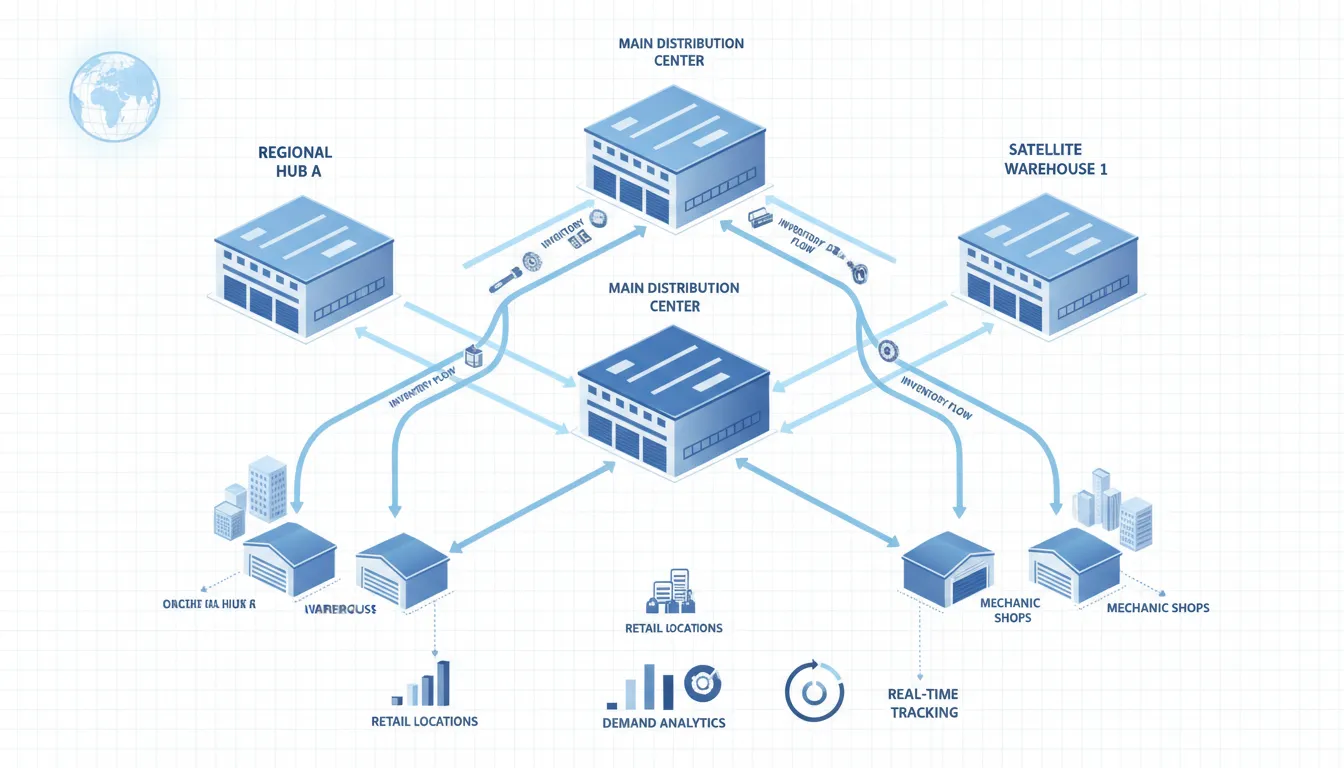

A tire distributor ERP RFP should describe how your business buys, stores, prices, sells, and delivers tires—not just list software features. Include your current workflows, operating requirements, integrations, data migration needs, implementation expectations, and a consistent way for vendors to demonstrate each requirement. This guide lays out a practical structure your team can adapt to compare systems on the work they must support.
Why Should a Tire Distributor ERP RFP Start With Workflows?
QBC Systems recommends describing the operating work behind the software decision before asking vendors to present features. A distributor's requirements may span purchasing, receiving, warehouse inventory, pricing, order entry, point of sale, delivery, accounts, and customer service. If the RFP begins with generic feature names, vendors may respond with different interpretations, making their proposals hard to compare.
Start by following a typical transaction from beginning to end. For example, trace a replenishment order from identifying a stock need through purchase, receiving, put-away, availability, customer order, pick, shipment, and invoice. Then document what happens when the process is less routine: a tire is unavailable, a shipment arrives short, a customer needs a substitute, or stock sits at another location.
Include the staff roles involved and the information each needs at each step. A warehouse manager may need to confirm physical availability, while a customer service representative needs to answer a call without promising stock that is already allocated. A purchasing lead may need to understand demand and supplier commitments. These are requirements to investigate and document, not assumptions that every ERP handles them the same way.
For background on the category, QBC's guide to ERP software explains the broader purpose of an ERP system. Keep this RFP more specific: define what a system must do for wholesale tire distribution and how your team will verify it.
What Business Context Should the RFP Give Vendors?
QBC Systems advises distributors to provide enough context for vendors to respond to the actual operation. A short company and process profile helps explain why a requirement matters and whether it applies across the whole business or only to a particular site, team, or customer group.
Describe your operation in factual, operational terms. Include the number and purpose of locations, the roles that use the system, the channels through which orders arrive, and the broad categories of products and customers you serve. If a fact varies by season or location, say so. Do not make vendors infer the shape of your business from a feature checklist.
- Locations and movement: Identify warehouses, branches, and the common ways stock moves between them.
- Order channels: Note phone and back-office order entry, sales representatives, point-of-sale activity, and any B2B ordering portal in use or under consideration.
- Product and customer variation: Explain relevant tire categories, account types, pricing rules, promotions, rebates, and quote practices.
- People and responsibilities: Name the functions involved—such as purchasing, warehouse, sales, customer service, finance, and management—without assuming one person owns every process.
- Existing systems and records: List the current software, spreadsheets, data sources, and external services that may need to exchange information with the new system.
Separate current facts from desired future changes. For instance, if several locations use different receiving steps today, state that plainly and identify whether standardization is a project goal. This distinction helps vendors explain what the proposed system supports, what configuration or process work may be needed, and what assumptions their response depends on.
Which Functional Requirements Matter in Tire Distribution?
QBC Systems suggests organizing requirements by the lifecycle of inventory and orders so the RFP reflects daily distribution work. TireServ is QBC's ERP for tire and automotive supply distributors; the relevant evaluation areas can include inventory, purchasing, point of sale, order processing, reporting, and B2B customer ordering. Vendors should show how their own systems address your needs rather than simply mark a feature as available.
For each process, state the business outcome, the information staff need, and the exception the system must handle. For example, “support inventory visibility” is too broad to score consistently. Ask whether users can find availability by location, distinguish stock status in a way that fits your process, and see what happens when an item is committed to an order. Ask the vendor to demonstrate with a scenario your team recognizes.
| RFP area | What to describe or request | Evidence to ask for |
|---|---|---|
| Inventory and locations | How staff check availability, receive stock, handle adjustments, and view inventory across warehouses. | A walkthrough using a sample item, location, receipt, and stock inquiry. |
| Purchasing and replenishment | How buyers identify needs, prepare purchase orders, receive items, and address shortages or discrepancies. | A scenario from purchase decision through receiving and updated availability. |
| Pricing, quotes, and promotions | Which account or order circumstances affect pricing, quotes, promotions, rebates, and margin review. | A sample customer transaction showing the applicable rules and resulting documents. |
| Order entry and fulfillment | How phone, counter, representative, and online orders enter the workflow and move to picking, shipment, and billing. | A demonstration following an order through the steps relevant to your operation. |
| Finance and reporting | Required accounting processes, management views, operational reports, and access to transaction history. | Examples of reports or inquiries, with the source data and filters explained. |
| Customer access and portals | Whether customers need to check product information or place orders through a B2B portal, and what information they may access. | A portal walkthrough tied to a defined customer ordering scenario. |
Use the table as a starting point, then add the requirements that distinguish your business. QBC's TireServ overview and TireServ distribution ERP page offer product context. For more detailed process questions, see the guides to a tire distributor POS system and tire wholesale B2B ordering.
How Should You Define Inventory and Warehouse Scenarios?
QBC Systems recommends asking vendors to demonstrate the inventory situations that drive decisions in your warehouses. A general promise of “real-time inventory” does not explain how your team will resolve competing orders, find stock, handle receiving differences, or decide whether a transfer is appropriate.
Choose a small set of representative scenarios and write them as test cases. Use realistic but non-sensitive sample data. State what the user starts with, what action they take, and what result they should be able to see. Avoid prescribing a screen design unless a specific interface behavior is essential; the objective is to verify the operational result.
- Check stock across locations: Ask the vendor to show how a user locates an item and understands its availability at the relevant warehouses.
- Receive a partial or discrepant shipment: Ask what staff record when the quantity received differs from the purchase documents, and what information remains available afterward.
- Fulfill an order with an exception: Show what happens if the preferred location cannot fill the full order or a substitute needs consideration.
- Review a transfer: Trace a proposed warehouse-to-warehouse movement, including the information needed to decide, record, and follow up on it.
These prompts are evaluation scenarios, not claims that every business uses the same process. Your team should adapt them to its own policies. QBC's resources on multi-location tire inventory, warehouse-to-warehouse tire transfers, and wholesale tire inventory practices can help identify questions worth including.

What Should the RFP Ask About Integrations and Data?
QBC Systems recommends treating integrations and data migration as explicit project requirements, not assumptions to resolve after vendor selection. A distributor may rely on accounting processes, customer-facing ordering, supplier information, shipping workflows, payment services, or other business applications. Your RFP should identify what exists today and ask each vendor to explain the proposed connection, responsibilities, and limits.
Create a simple inventory of systems and data exchanges. For each one, record its purpose, the information involved, how often it changes, who owns it, and whether it is essential on day one. Ask vendors to distinguish a current supported integration from a possible custom connection or a manual workaround. Request a diagram or written explanation that shows where data originates and where it is used.
Data migration needs the same clarity. List major records to consider, such as products, customer accounts, supplier information, price-related records, open transactions, and history. The exact scope depends on your operation. Ask how data will be mapped, cleaned, tested, reconciled, and approved; who is responsible for each task; and how staff will verify that migrated records support the work they need to do.
Include questions about access, backup, security practices, and service responsibilities that are appropriate to your organization. Ask the vendor to describe its approach and provide relevant documentation during the evaluation. Do not treat a broad assurance as a substitute for specific written answers to your requirements.
How Can You Compare Vendor Responses Fairly?
QBC Systems recommends using one response format and one scoring method for every vendor. A consistent process helps your team distinguish a feature that exists from a requirement the vendor has actually demonstrated, and it makes assumptions easier to spot.
For each requirement, ask vendors to choose a response such as supported as standard, configurable, dependent on integration, custom work, not supported, or needs clarification. Give them space to describe the process, identify prerequisites, name any third-party component, and state what evidence they can provide. Ask for estimated project effort in a way that fits your procurement process, without relying on a vague “included” label.
Then define a simple internal score. One option is to rate each requirement for importance, vendor response, and demonstration result separately. A high-priority requirement that is only described in writing should not receive the same confidence as one your team has watched work in a relevant scenario. Record open questions and assign an owner to resolve each before a decision.
- Fit: Does the response address the actual process and exception described?
- Evidence: Did the vendor provide documentation or demonstrate the result with an agreed scenario?
- Dependencies: Does the answer rely on configuration, another provider, custom work, or changed procedures?
- Operational effect: Which roles, sites, and handoffs would be affected?
- Uncertainty: What remains unverified, and what must be answered before selection?
Schedule demonstrations around the same scenarios for each vendor. Give attendees a shared score sheet and capture observations promptly. Keep sales presentations separate from requirement evidence: a clear product overview is useful, but it does not answer whether the system supports a specific warehouse or order process.
What Should You Include in Implementation and Support Requirements?
QBC Systems advises distributors to define the people, timing, and operating responsibilities involved in the change. A software proposal is only one part of the evaluation; implementation planning, training, support, and the transition from current processes need to be addressed before commitments are made.
Ask each vendor to describe typical project phases and what the distributor must contribute. Clarify who leads data preparation, configuration, testing, user training, and go-live readiness. Request a sample project plan that identifies decision points, dependencies, customer responsibilities, and the way changes to scope are handled. Your team should judge the plan against its own calendar and staffing constraints.
Training should reflect real roles and tasks. Ask how warehouse users, order-entry staff, purchasing, finance, and administrators will learn the parts of the system they use. Ask what materials are available for later reference and how new staff can be brought up to speed. Confirm how users can raise support questions, what information is required to report a problem, and how the vendor explains coverage and escalation.
Also address technical ownership. If hardware, network services, or data-center needs are in scope, say so explicitly and ask vendors to identify what they provide and what remains with your existing IT provider. QBC's automotive ERP implementation guide can help frame implementation questions. Its hardware and network services page describes the separate infrastructure and managed IT context.

How Do You Turn the RFP Into a Practical Next Step?
QBC Systems recommends keeping the final RFP focused enough that vendors can answer clearly and your team can evaluate the answers. Before issuing it, review every requirement with the people who perform the work. Remove duplicates, explain unfamiliar terms, and label each item as essential, preferred, or out of scope for the current decision.
Use this final review before sending the document:
- Confirm that the RFP describes your distribution workflows and important exceptions, not just a list of software modules.
- Check that each high-priority requirement has a measurable response or demonstration request.
- Identify integrations, data sources, migration responsibilities, implementation needs, and training expectations.
- Give vendors clear instructions for assumptions, dependencies, evidence, and unanswered items.
- Plan who will review responses, attend demonstrations, score evidence, and approve the next step.
A useful RFP does not need to prescribe the vendor's product. It needs to make your operating needs visible and create a fair way to test how each proposed system addresses them. For more on QBC Systems and its distribution focus since 1978, visit the company overview. If your team is considering a tire-distribution ERP, you can contact QBC Systems to discuss your requirements.
Contact Us for a Free Consultation
Frequently Asked Questions
QBC Systems offers these answers to common questions distributors may have while preparing an ERP RFP.
How long should a tire distributor ERP RFP be?
There is no single ideal length. Include enough detail for vendors to understand your workflows, priorities, data, integrations, and project expectations, but remove repeated or low-value questions. A concise process map and a clear response template can be more useful than pages of unranked feature requests.
Should we include our current software and process problems?
Yes. Describe the systems and workflows that matter to the decision, along with concrete examples of friction or risk. Be factual and distinguish a current limitation from a desired future process. This gives vendors context without requiring them to guess what the business needs to change.
Should vendors demonstrate every RFP requirement?
Focus demonstrations on high-priority requirements and scenarios where a written response is not enough to establish fit. Ask for clear written answers on the remaining items, and record which claims are demonstrated, documented, dependent on other work, or still unresolved.
When should we discuss implementation?
Discuss it during the selection process, before choosing a system. Ask vendors to outline project responsibilities, data work, training, testing, support, and key dependencies so your team can evaluate the full change rather than software functionality alone.
A well-prepared RFP gives tire distribution teams a practical basis for comparing systems against real work, asking better questions, and deciding what needs to be verified before moving forward.