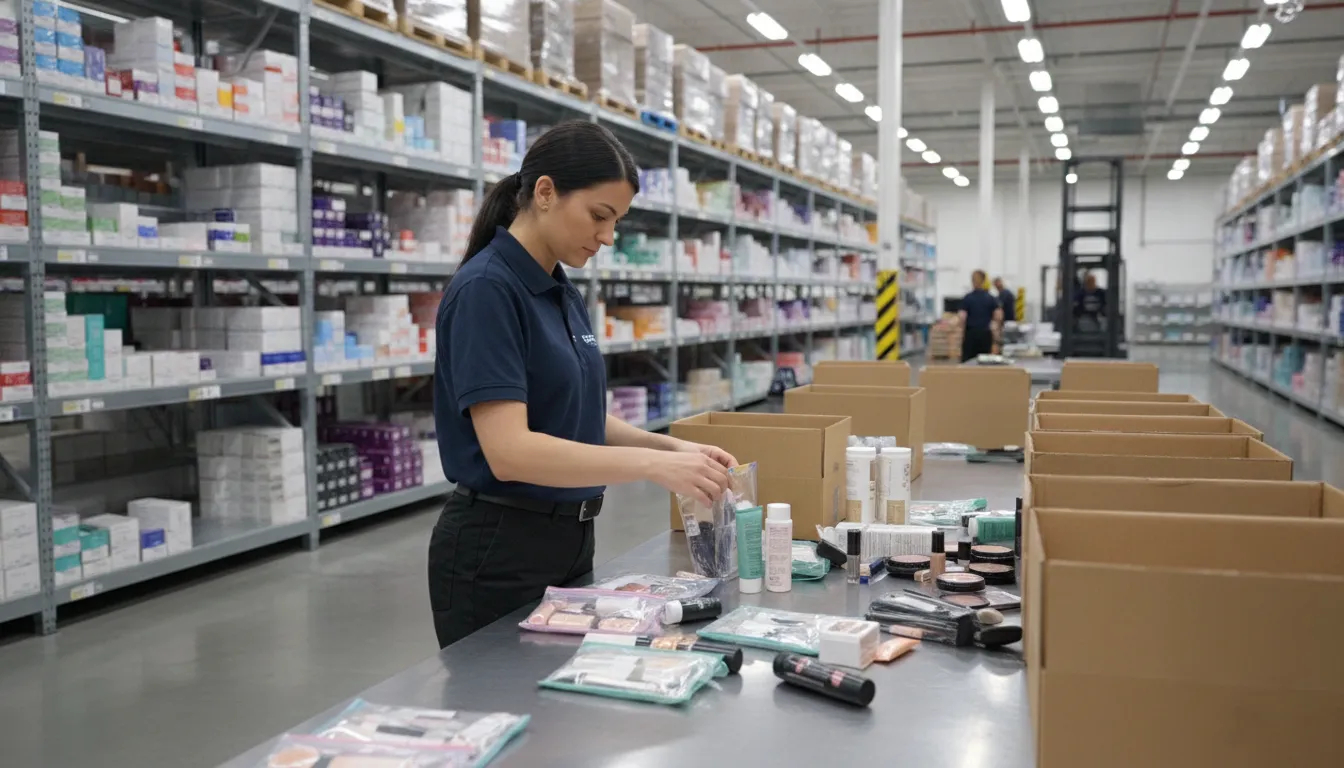

Beauty and cosmetic wholesale warehouses rarely struggle because one product is difficult to store. The pressure comes from managing thousands of product variations, keeping stock accurate, and moving items before their useful selling window narrows. A disconnected spreadsheet and picking process makes those tasks harder to control.
A cosmetic warehouse management system gives distributors one operational view of SKUs, lot numbers, expiration dates, and available stock. That supports more consistent receiving, picking, replenishment, and shipment tracking, while helping teams apply rotation rules such as first-expired, first-out. The right system should fit the distributor's product mix and warehouse process, not force staff to work around generic tools.
Schedule a Demonstration
The first step is understanding what this type of system actually manages and where it fits within a broader wholesale ERP. That foundation makes it easier to compare options based on daily warehouse needs rather than a long feature list.
What Is a Cosmetic Warehouse Management System?
QBC Systems defines a cosmetic warehouse management system as software that helps beauty and cosmetic wholesale distributors control inventory from receiving through order fulfillment. It gives warehouse and operations teams a more dependable view of what is in stock. Where it is located, which lot it belongs to, and how long it can remain available for sale.
That matters because cosmetics are rarely a simple one-item-per-product operation. A single product line may include multiple shades, sizes, formulas, packaging formats, or seasonal versions. Industry research describes the category as having countless SKUs and product variations, making inventory and logistics harder to manage with disconnected spreadsheets or broad, manual processes. Learn more about cosmetic inventory complexity.
What does the system track?
At a practical level, the system creates a record for each stock item and connects that item to the information warehouse staff need during daily work. A cosmetics-focused WMS can track:
- SKUs: The individual products, variants, and pack configurations your team receives, stores, picks, and ships.
- Lot numbers: The batch or production information associated with inventory, supporting traceability when a product needs to be reviewed or recalled.
- Expiration dates: The date information needed to identify aging inventory and make better decisions about how orders should be picked.
- Stock levels and locations: The quantity available and the warehouse location where staff can find it.
These functions work together. Tracking an expiration date is less useful if the team cannot locate the affected units. Likewise, knowing the quantity on hand is not enough if the available stock belongs to a lot that should be held or rotated first. A WMS for cosmetics is designed to connect those details in one operating view. Industry guidance on cosmetics warehousing identifies SKU, lot, and expiration tracking as core parts of this approach.
Who benefits from a cosmetic WMS?
Beauty supply wholesalers, cosmetic distributors, and warehouse teams handling a broad catalog can use this type of system to keep inventory records more precise. Better tracking helps reduce the risk of stockouts and excess inventory, while giving managers clearer information for replenishment and order planning. It also gives pickers more useful direction during fulfillment instead of requiring them to interpret separate lists or rely on memory.
For distributors evaluating a broader beauty supply wholesale ERP software platform, warehouse management is one part of the larger picture. The goal is not to add another isolated tool. It is to connect purchasing, inventory, warehouse activity, and customer orders so the operation can make practical decisions using the same underlying information.
Why Cosmetics Distribution Is Hard to Manage Without the Right System
QBC Systems understands that cosmetics distribution is not simply a matter of moving boxes from receiving to shipping. A distributor may manage a broad catalog of shades, sizes, formulas, packaging changes, and customer-specific assortments, often while products have different shelf-life requirements. Those details create operational work that spreadsheets, paper pick tickets, and disconnected inventory records struggle to handle consistently.
High SKU density makes manual inventory control unreliable
Cosmetics warehouses often carry numerous SKUs and product variations. A small difference in shade, size, scent, packaging, or kit configuration can represent a separate item that must be received, stored, picked, and replenished correctly. Industry research identifies this combination of countless SKUs and variations as a central challenge in beauty and cosmetics logistics. Product variation increases the complexity of cosmetic inventory management, especially when staff rely on memory or manually maintained worksheets.
Manual methods also make it harder to maintain a dependable picture of available stock. Counts become outdated as orders are entered, items are moved, and returns are processed. The result can be excess inventory in one location, stockouts in another, or an avoidable rush to locate products before an order ships.
Shelf life and product quality cannot be treated as afterthoughts
Expiration dates matter because cosmetics can lose quality or become unsuitable for sale as they age. Effective expiration-date management is essential for protecting product quality and supporting sound warehouse decisions. Precise expiration tracking is a documented cosmetics logistics requirement, not just a convenience for larger distributors.
Without item-level date and lot information, warehouse staff may pick newer stock while older product remains in a bin. That shortens the time available to sell the older inventory and can contribute to truncated product life cycles in a disorganized supply chain. A suitable cosmetic warehouse management system gives managers a better basis for rotation decisions, instead of leaving them to visual checks and manual notes.
Recalls and growth add pressure to weak processes
When a product issue or recall arises, a distributor needs to identify affected lots and determine where those products went. Batch and lot records support that investigation, while disconnected systems can turn a focused response into a warehouse-wide search.
The pressure will not lessen as the market grows. The cosmetics industry is expected to grow significantly over the next five years. Increasing the need for supply chain processes that can handle more activity without multiplying manual work. Specialized cosmetics warehousing practices help distributors prepare for that pressure by making inventory, shelf-life, and fulfillment information easier to manage in daily operations.
What to Look For in a Cosmetic Warehouse Management System
QBC Systems recommends evaluating a cosmetic warehouse management system against the work your team does, not the features in a demo. The right system should make inventory easier to identify, rotate, pick, and trace across your operation.
Lot, batch, and expiration tracking
Lot tracking should connect each product to its lot number, batch information, received date, and expiration date. This gives warehouse staff a usable record when a customer asks about a shipment or when a recall requires you to identify affected inventory. Batch management is also important for quality control because it can trace individual cosmetic shipments. Industry guidance identifies lot tracking as a critical part of managing expiration dates and product quality.
Look for configurable alerts and reports, rather than a field that simply stores an expiration date. Managers should be able to see products approaching expiration, place inventory on hold, and review movement by lot without rebuilding the answer from spreadsheets.
Barcode scanning and practical pick paths
Barcode scanning helps staff confirm the item and quantity at receiving, picking, packing, and shipping. It reduces dependence on memory and handwritten checks, particularly when similar products have different shades, sizes, or packaging. A system that supports optimized pick paths can also reduce unnecessary travel through the warehouse. Together, barcode scanning and pick-path controls are intended to reduce manual errors and improve fulfillment efficiency, as documented by Logiwa.
During an evaluation, ask whether scanners work with your existing labels and hardware. Also ask what happens when a barcode is missing, damaged, or duplicated. A good process should provide a controlled exception workflow instead of forcing employees back to an informal workaround.
FIFO and FEFO stock rotation
Expiration tracking should support the rotation rule that fits the product and your operating policy. FIFO, or first in, first out, moves older received stock first. FEFO, or first expired, first out, prioritizes the product with the nearest expiration date. For cosmetics with different shelf lives, FEFO may be the more useful rule. But the system should let your team define and monitor the policy rather than rely on guesswork.
Multi-warehouse and e-commerce connectivity
If you stock products in more than one facility, review how the system shows available inventory by warehouse, transfer status, and allocation. The multi-warehouse cosmetics software guide can help frame the questions to ask about location-level control. You should also review how orders from an e-commerce store enter the warehouse workflow, including inventory updates, order status, backorders, and returns. These connections matter because online orders should use the same accurate stock picture as phone, sales-representative, and counter orders.
Finally, assess whether the platform can grow with additional SKUs, locations, users, and sales channels. QBC Systems describes scalable functionality as an important consideration for growing beauty operations. For a broader review of receiving, counting, and replenishment processes, see this guide to cosmetic distributor inventory control.
Cosmetic Warehouse Management System vs. a General-Purpose WMS
QBC Systems recommends comparing warehouse software against the work your team actually performs, not just the feature list on a vendor page. A general-purpose WMS may organize locations and orders effectively, but cosmetics distribution adds product variations, lot controls. Expiry decisions, and recall traceability that can change how inventory should be received, stored, picked, and shipped.
The practical difference is whether these requirements are built into daily workflows or handled through spreadsheets, notes, and manual checks. The comparison below is a starting point for evaluating fit.
| Operational need | Cosmetics-grade WMS | General-purpose WMS |
|---|---|---|
| Lot and expiry tracking | Tracks lot numbers and expiration dates as part of inventory control, supporting FIFO or FEFO rotation. Lot and expiry guidance | May track lots or dates, but the fields and rotation rules may require configuration, add-ons, or manual work. |
| SKU complexity handling | Designed for numerous SKUs, product variations, sizes, shades, and pack configurations common in beauty distribution. | Can manage standard item records, but complex variations may need workarounds or additional setup. |
| Batch and recall traceability | Connects batch or lot records to receipts, inventory, and shipments so affected products can be identified more precisely during a recall. | Traceability depends on the system's lot functionality and how consistently warehouse staff capture the data. |
| Regulatory compliance support | Provides records and controls that support documented handling, labeling, lot history, and expiry management. It supports compliance work, but does not replace regulatory advice. | May provide general inventory records without workflows tailored to cosmetic storage and distribution requirements. |
| Sales and implementation support | Typically includes guidance for configuring cosmetic workflows, training warehouse staff, and connecting inventory with broader distribution operations. | Support may focus on software configuration, leaving the distributor to translate cosmetic-specific requirements into processes. |
These distinctions matter most when inventory is moving quickly or when an older lot must be located before it becomes unsellable. Expiration management is central to cosmetic quality, while batch management helps trace individual shipments if a product recall occurs. Barcode scanning and optimized pick paths can also reduce manual errors during fulfillment.
A general-purpose WMS is not automatically the wrong choice. It may be reasonable for a distributor with straightforward products and limited lot or expiry requirements. For a beauty wholesaler managing many variations across locations, however, a beauty supply wholesale ERP software platform should connect warehouse controls with purchasing, sales, inventory, and implementation support. That integrated view is often more useful than adding isolated warehouse features later.
A Practical Step-by-Step Way to Adopt a Cosmetic Warehouse Management System
QBC Systems recommends treating implementation as an operations project, not simply a software installation. The goal is to make product identification, rotation, picking, and staff decisions more consistent without disrupting daily orders. A practical rollout can follow these five steps.
- Map your SKU, lot, and expiry needs. Start with the inventory you actually handle. Document product variations, case and each-unit quantities, lot or batch numbers, expiration dates, locations, and common receiving or picking exceptions. Cosmetics often involve numerous SKUs and variations, so this inventory map gives the implementation team a clear picture of what the system must track. Precise expiration management is especially important for maintaining product quality. Review the documented inventory challenge before finalizing your requirements.
- Define your rotation rules before configuration. Decide when employees should use FIFO, or first in, first out, and when FEFO, or first expired, first out, is the better rule. FEFO is generally the more useful approach when expiration dates differ across lots, while FIFO may fit products where age is the primary concern. Write down exceptions, such as customer-specific requirements, damaged stock, quarantined goods, and short-dated inventory. A system can enforce the rule, but your team must agree on it first.
- Set up labels and barcode scanning. Standardize the information shown on receiving, bin, case, and shipment labels. Then test barcode scans at receiving, putaway, picking, packing, and returns. Accurate scanning and better pick paths can reduce manual entry errors, but only when labels are readable and every key item has a clear process. Test representative products, including multipacks, sample sizes, and items with different lots.
- Train warehouse staff around real tasks. Train by workflow rather than by feature list. Have employees practice receiving a shipment, locating a lot, selecting the correct expiry, handling an exception, and completing a return. Ask experienced staff where the proposed process conflicts with the way orders move today. Their feedback can identify unclear labels, missing permissions, or unnecessary steps before launch.
- Go live in a controlled rollout with support. Confirm opening inventory, locations, user access, scanners, and order integrations before switching over. If possible, begin with a defined warehouse area or order group, compare system results with physical counts, and correct process gaps quickly. Keep implementation and support contacts available during the first shipping cycles. QBC Systems can help distributors evaluate beauty supply wholesale software in the context of their warehouse and distribution processes.
This sequence keeps the focus on decisions that affect daily accuracy. It also gives warehouse managers measurable checkpoints before expanding the system to additional locations, product lines, or workflows.
Regulatory Compliance and Expiry Management in Cosmetics Warehousing
QBC Systems helps cosmetic distributors connect regulatory controls with the warehouse tasks that protect product quality, including receiving, lot assignment, storage, picking, and shipment records. A cosmetic warehouse management system cannot replace legal or quality advice, but it can give your team the records and operating discipline needed to apply those requirements consistently.
What FDA guidance means for shelf life and expiration dates
The U.S. Food and Drug Administration explains that federal law generally does not require cosmetic products to carry an expiration date. However, manufacturers and distributors remain responsible for ensuring products are safe and not adulterated when used as directed. When a business assigns or relies on shelf-life information, that information should be supported by the product owner's quality process rather than treated as an arbitrary warehouse field.
For warehouse managers, the practical issue is control. The system should capture the lot or batch received, the date received, any available expiration or best-by information, and the quantity tied to that record. Staff can then identify inventory that needs review before it is picked, transferred, or shipped. See the FDA's guidance on shelf life and expiration dating for cosmetics for the agency's explanation of expiration-date responsibilities.
How MoCRA changes the compliance conversation
The Modernization of Cosmetics Regulation Act of 2022, or MoCRA, expanded the federal framework for cosmetics. FDA information on MoCRA covers requirements and authorities related to facility registration, product listing, adverse-event reporting, records access, and good manufacturing practice standards. Not every obligation belongs to the warehouse, and distributors should confirm their responsibilities with qualified regulatory counsel and their suppliers.
Even so, warehouse records are part of an accountable supply chain. A distributor should be able to answer basic questions about what arrived, which lot was handled, where it was stored, and which customers or orders received it. Consistent records make it easier to respond when a supplier issues a quality notice or when a recall investigation requires shipment-level detail.
Why lot records support recalls and FEFO rotation
Batch management is required to trace individual cosmetic shipments during a product recall. Lot tracking supports recall traceability, expiration management, and quality control. Without it, teams may have to search invoices, spreadsheets, and paper documents to estimate which inventory is affected. That process is slower and more likely to miss a carton or customer shipment.
Lot and date data also support FEFO, or first expired, first out, rotation. Instead of shipping only the oldest receipt, the warehouse prioritizes the eligible lot with the nearest expiry date. Exceptions still need judgment, since damaged packaging, customer requirements, and supplier instructions may change the correct action. The system should make those exceptions visible, not hide them inside an informal note.
For a practical implementation, define which date fields each supplier provides, set review rules for short-dated stock, and require lot capture at receiving and picking. Then train staff to follow the same process on every shift. That combination turns compliance from a periodic scramble into a repeatable warehouse control.
Why Cosmetic Distributors Trust QBC Systems
QBC Systems has served distributors since 1978, giving cosmetic and beauty supply wholesalers a technology partner that understands the practical demands of distribution. The goal is not to force warehouse teams into a generic process. It is to help them manage products, orders, inventory, and customer commitments with systems that fit the way their business operates.
BeautyServ is built around wholesale distribution
Beauty supply distribution involves more than keeping a list of products in stock. Teams may need to manage large product assortments, variations, kits, purchasing, receiving, picking, and order fulfillment across day-to-day warehouse activity. BeautyServ ERP is QBC's vertical solution for beauty supply wholesale, bringing those operational needs into one connected system.
That vertical focus matters when an inventory manager is trying to answer straightforward questions: What is available to promise? Which items need attention before they expire? Where is a product located? What should be picked for the next order? A system should make those answers easier to find and act on, rather than adding another layer of work.
For a broader look at the capabilities distributors should expect, review QBC Systems' beauty supply wholesale ERP software guide. It provides useful context for evaluating software around purchasing, inventory, warehouse operations, and order management.
A full-service partner beyond the software
QBC Systems supports more than the software license. Its service model includes implementation, staff training, ongoing technical support, hardware, networking, data center solutions, and managed IT services. That gives a distributor a place to turn when the work involves both the ERP and the technology environment that keeps warehouse operations running.
This consultative approach is especially useful when a business is replacing disconnected tools or standardizing processes across locations. QBC can help the team identify what needs to change, prepare staff for the new workflow, and provide support after the system is in use. The emphasis is on practical adoption, not simply delivering software and leaving warehouse employees to figure it out alone.
Distributors managing bundled products or salon and beauty supply kits can also explore QBC's beauty supply kit management ERP resources. The right setup should reflect how products are purchased, stored, assembled, and sold in the distributor's actual operation.
For cosmetic distributors, trust is built through relevant experience and dependable support. QBC Systems combines long-term distribution experience with a vertical ERP platform and hands-on services designed to help warehouse and operations teams work with greater control.
Schedule a Demonstration of Your Next Warehouse System
Frequently Asked Questions
What is a cosmetic warehouse management system?
QBC Systems describes a cosmetic warehouse management system as software built to organize beauty wholesale inventory at the operational level. It can track SKUs, lot numbers, and expiration dates. Giving warehouse teams a clearer view of what is available, where it is stored, and which products should move first.
How does a WMS improve cosmetic fulfillment?
A WMS improves fulfillment by giving staff defined pick paths and barcode scanning tools. These controls reduce reliance on handwritten notes and memory, helping teams select the correct products and quantities with fewer manual errors.
Why is lot tracking important in cosmetic warehousing?
Lot tracking connects inventory to a specific batch, which supports expiration management, quality checks, and faster tracing if a product needs to be reviewed or recalled. It also helps distributors identify which shipments may be affected instead of searching through all available stock.
How do you manage expiration dates in cosmetic wholesale?
Track expiration dates by batch and use a first-expired, first-out, or FEFO, process when setting pick priorities. This approach helps warehouse staff move products with the shortest remaining shelf life before newer stock, while keeping aging inventory visible for review.
Schedule a Demonstration of Your Next Warehouse System
QBC Systems can help you evaluate how a cosmetic warehouse management system fits your distributors' day-to-day inventory and fulfillment work. A practical demonstration gives your team a clearer way to discuss workflow needs, system capabilities, and implementation questions before making a decision. To review your operation and see the BeautyServ approach, Schedule a Demonstration with QBC Systems.