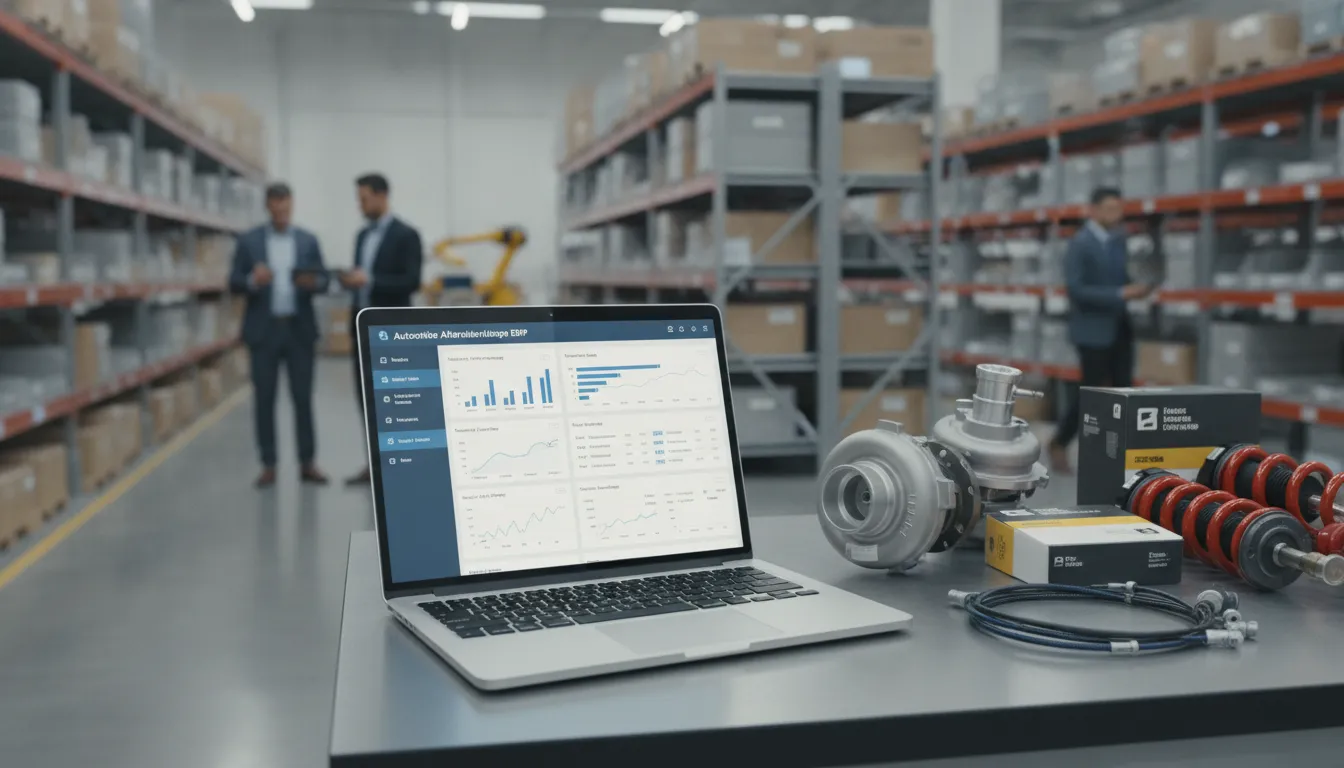
Manual order entry and blind stock tracking slow down auto parts distributors until customers walk away. When warehouse workers spend hours searching for a single brake pad, delivery trucks sit empty. Operational friction like this drains margins and stunts company growth.
Automotive aftermarket ERP software is a specialized business management platform that connects parts catalogs, warehouse inventory levels, and financial records for parts distributors. This unified tool lets warehouse staff search fitment data, track serial numbers across multiple locations, and process complex customer orders without slow manual steps. Because auto supply chains handle thousands of different parts, having real-time data is vital to help your team prevent stockouts and manage shipping dates. Using an industry-specific system helps wholesale teams prevent double-entry errors, organize incoming supplier shipments, and fulfill orders faster to keep parts buyers happy. According to a study on automotive technology, ERP integration streamlines production, logistics, and financial processes to promote operational transparency and reduce overall costs. To streamline your parts distribution workflow, schedule a demonstration with QBC Systems today.
Many parts distributors often wonder how to choose a system that fits their unique warehouse needs. To understand how these platforms organize your daily workflow, we must first define the core technology. The path begins with What Is Automotive Aftermarket ERP Software?
What Is Automotive Aftermarket ERP Software?
At QBC Systems, we define automotive aftermarket ERP software as a specialized management platform built to run every part of a parts supply business. This software brings your inventory, sales, and supply chain into one single database. Research shows that standard ERP systems in the automotive industry streamline production, logistics, and financial processes to make work clear and lower costs. For aftermarket distributors, these tools are the backbone of daily work.
The core role of aftermarket software
Managing thousands of parts, fitment codes, and cross-references is too hard for generic business tools. An automotive aftermarket ERP is built from the ground up for this complexity. It connects your front counter, warehouse, and back office in real time. This means when a customer buys a part, your stock count updates instantly across all your stores and warehouses.
Many wholesale distributors use these systems to manage both passenger tires and specialty auto parts. If you handle mixed inventory, you may need specific tire wholesale and distribution ERP solutions to track brand-specific fitment and tread wear. Having a single hub for both tires and parts keeps your warehouse running without costly mix-ups.
Who does this software serve?
This system is built for businesses that sell car parts and accessories after the vehicle is made. This includes parts distributors, warehouse distributors, retail auto stores, and jobber stores. These teams must manage a massive list of part numbers from hundreds of different suppliers. They also must handle complex shipping rules, core tracking, and warranty returns every day.
Without the right software, these businesses struggle to keep up with fast-changing supply chains. A specialized system helps warehouses synchronize orders with supplier catalogs and shipping times. This helps counter staff find the exact part a mechanic needs in seconds. It also helps managers plan purchases based on real sales data, not just guesses.
How it differs from standard ERP
Standard business software is made for simple products with one part number. But car parts have fitment requirements, meaning they only fit certain vehicle years, makes, and models. An aftermarket system integrates industry-standard databases directly into your sales screen. This lets your team look up a part by vehicle fitment or license plate, which a basic system cannot do.
Also, most standard software vendors just sell you a license and leave you to set it up alone. At QBC Systems, we know that buying software is only the first step. Our full-service model gives you ERP software, setup, training, technical support, hardware procurement, networks, data center solutions, and managed IT services. This complete partnership ensures your team has everything needed to succeed.
Key Features of an Automotive Aftermarket ERP System
To succeed in a complex industry, QBC Systems helps parts sellers streamline their work with an automotive aftermarket erp. Many distributors start with generic business software, but they soon face limits. According to a study on ERP implementation, standard ERP packages track core areas like purchasing, inventory control, sales, and financial tracking. Yet, these tools lack the features to handle the deep parts data that aftermarket shops use every day.
Inventory tracking and fitment data
An automotive aftermarket erp must track parts by fitment, also known as application data. This feature links specific parts to vehicle years, makes, and models. A generic tool only lists a part number and a count, which leads to ordering errors.
Tailored software lets counter staff find the exact match for a vehicle in real time. This prevents costly parts returns and keeps warehouse inventory levels correct. Staff can track stock across several bins and store sites with ease.
Supplier catalogs and point of sale
To keep business moving, aftermarket shops must connect to supplier networks to check stock and pricing. Distributors use these connected catalogs right at the point of sale. This link lets staff create special orders and buy parts without leaving the sales screen.
These systems also run a B2B portal where wholesale buyers can place orders online. A custom platform unites these tasks to speed up order times. Buyers can search parts by brand or category, view real-time stock levels, and check their custom pricing.
While basic systems offer generic features, specialized software has unique automotive aftermarket ERP features to handle part fitment and catalog search. This includes point of sale tools designed for counter sales, walk-in customers, and fast wholesale quotes. Sellers can manage high sales volume while tracking credits and cores on the same bill. To see the difference, review how generic business software compares to a tailored platform like TireServ.
| Feature Category | Generic ERP Software | Aftermarket ERP (TireServ) |
|---|---|---|
| Inventory Setup | Tracks basic part numbers. | Links parts to vehicle fitment and application. |
| Supplier Ordering | Requires manual stock checks. | Connects live to parts supplier catalogs. |
| Sales Counter | Standard invoice screen. | Includes point of sale and core tracking. |
| Customer Portals | Basic online ordering. | B2B portal with live fitment search. |
| Financial Control | General ledger tracking. | Industry-specific cost and margin tracking. |
Financial tracking and reporting
To protect your bottom line, keeping cash flow and margins strong needs precise cost tracking across warehouse sites. The software gives real-time financial reporting on core returns, core credits, and supplier rebates. These reporting tools help managers see margins by product line and customer type. With these clear insights, shops can adjust pricing to protect profits.
How Does ERP Improve Inventory and Order Management for Auto Parts?
At QBC Systems, we focus on delivering automotive aftermarket ERP systems that solve tough inventory problems for parts distributors. With the right system, you can connect your stock data, warehouse bins, and sales workflows in one place. This saves your team time, cuts down on human error, and ensures that you can always find the parts your customers need.
Real-time visibility across warehouses
Many distributors store parts in more than one place. Real-time data must be open to all workers so they can find parts fast. When you have live stock data, you can fill orders without delay. This live view stops you from selling parts that are already out of stock. It also ensures that your sales team can promise accurate delivery dates to buyers.
Managing a massive variety of parts is hard because of automotive supply chain complexity. A study on supply chain integration shows that real-time data is needed to sync supplier order processing when product variety is high. With the right software, you can track stock across all warehouse bins and locations. This helps you keep the right mix of parts on hand.
To keep your warehouse running smoothly, a complete inventory control system should help you:
- Track parts in real-time across multiple locations.
- Manage exact bin locations for faster picking.
- Set automated reorder points to prevent stockouts.
- Connect order processing with major suppliers.
Vehicle fitment and application data
Auto parts are not like general goods, as every part must fit specific vehicle makes and models. If you sell a brake pad that does not fit the buyer’s car, you face costly returns. An automotive supply chain software system links parts data to vehicle fitment lists. This ensures your staff always picks and ships the right part.
To keep order accuracy high, you must combine your catalog data with your sales platform. When a customer searches for a part, the system should check fitment first. This helps your team avoid order entry errors and reduces warehouse labor. Your business can handle more sales without hiring more staff to manage returns. You can also spot which car models drive the most parts sales.
Automated replenishment and bin management
Running out of fast-moving parts hurts your sales, while storing too many slow parts wastes your cash. Modern systems use automated replenishment to solve this problem. The software tracks sales trends and order speeds to find your best stock levels. It then drafts purchase orders for you when stock falls below a set point.
To manage stock well, you must use smart bin location workflows. Under a research paper on automotive ERP systems, core ERP modules must span purchasing and inventory control. When you combine these tools with clear bin maps, your team can find and pack parts with ease. This improves your overall order entry optimization and speeds up shipping.
Choosing the Right Automotive Aftermarket ERP
At QBC Systems, we know that finding the right automotive aftermarket ERP needs a close look at your daily work. Choosing a new platform is more than just buying software. You must find a tool that fits your warehouse size and catalog. If you also manage a tire supply business, check our tips on choosing ERP software for tire distribution to learn more.
Understanding Your Catalog and SKU Volumes
Automotive parts distributors manage some of the largest product catalogs in any sales sector. Your business may track hundreds of thousands of parts across many brands, years, and models. A generic ERP system often struggles to organize these complex lists without slow response times. A custom tool handles these big lists easily so your sales team can find parts fast.
A Five-Step ERP Evaluation Plan
To find the best fit, your team should follow a clear path. A structured choice helps you avoid costly errors and makes sure the tool supports your team’s goals. This checklist outlines the main steps to guide your search.
- Assess business size and SKU count: Count your active part numbers and warehouse sites to make sure the database can handle your volume. A high SKU count requires fast search and clean data tracking.
- Compare industry features to generic options: Compare systems built for parts sellers against basic accounting software. Industry tools offer built-in fitment lookups and supplier catalog links.
- Check support and training services: Look for a team that stays with you through the setup process. Research shows that over 90 percent of ERP implementations face delays and budget overruns due to high complexity.
- Compare the total cost of ownership: Assess the full cost of hardware, training, updates, and support over five years. Do not just look at the starting software license fee.
- Verify integration with your existing systems: Make sure the new software connects with your current shipping tools, B2B portals, and accounting ledgers. Safe data sharing prevents manual entry mistakes.
Avoiding Costly Implementation Pitfalls
Many distributors fail to plan for the human side of software changes. Setting up a new system needs real training and personal support. Instead of selling a self-serve SaaS utility, QBC Systems works as a plainspoken, consultative ERP partner. We believe that direct, expert guidance is the best way to keep your project on time and within your budget.
Integration with B2B E-Commerce and Supply Chain Systems
QBC Systems provides an automotive aftermarket ERP that connects e-commerce portals and supply chain systems to streamline how parts are shipped. By linking customer orders directly to warehouse records, this software ensures distributors can manage inventory and ship parts without manual data entry. Businesses use these tools to coordinate with suppliers, run customer portals, and keep stock counts accurate across all locations.
B2B portals and real-time stock counts
A modern automotive aftermarket ERP connects storefronts with back-office databases. When a repair shop or retail store places an order online, the system updates inventory levels in real-time. This instant flow of data helps distributors prevent stockouts and double-booking, which are common issues in busy warehouses. B2B customer portals allow partners to view live stock counts, verify fitment details, and track shipments on their own.
Showing live stock counts to trading partners reduces the need for constant phone calls and emails. Distributors can display accurate stock counts across multiple warehouse locations, which builds trust with buyers. Integrating these digital portals with the core database ensures that order entry is fast and error-free. This integration is a core part of a modern automotive supply chain software strategy.
Supplier integration and EDI tools
Efficient distribution relies on strong connections with parts manufacturers and suppliers. An automotive aftermarket ERP uses Electronic Data Interchange (EDI) to automate key orders, invoices, and shipping notices. This setup removes slow manual tasks and helps distributors stock their warehouses based on actual sales demand.
Using automated EDI and supplier tools helps warehouses manage complex supply chains in several ways:
- Fast order updates: Electronic documents flow between systems in seconds, which speeds up the fulfillment cycle.
- Simplified purchasing: The ERP can automatically generate purchase orders when stock drops below set levels.
- Supplier syncing: Managing many types of parts across many vendors requires real-time data to sync order processing, according to an academic study on ERP benefits.
Connecting the full distribution cycle
A fully integrated ERP ties all these moving parts into one smooth system. When e-commerce storefronts, warehouses, and suppliers are linked, business owners can track a part from the moment of purchase to final delivery. This end-to-end connection gives managers complete visibility over their operations and helps them make better business decisions.
Instead of relying on disconnected tools, distributors can run their whole business from a single platform. This approach reduces errors, lowers handling costs, and ensures that customers get their parts on time. By connecting B2B portals and supply chain tools, an ERP helps distributors stay ahead in a fast-moving aftermarket.
The QBC Systems Advantage for Automotive Aftermarket Distributors
QBC Systems serves as a plainspoken, consultative partner for small to mid-sized distributors, rather than a self-serve software tool. Most software companies leave you to set up the system on your own. But a successful setup for your automotive aftermarket ERP needs a hands-on approach. We work with your team to find the best way to run your business and avoid common software traps.
The consultative partner model
Many software setups fail because of high complexity. In fact, over 90% of ERP setups face delays and budget overruns due to complexity, according to a study on industrial ERP setups. QBC Systems helps you avoid these risks by offering a full-service model. We do not just hand you a login and walk away. Our team guides you through each step of the setup.
Our complete services include:
- ERP software designed for your trade
- Hands-on setup and team training
- Ongoing local tech support
- Getting hardware and setting up networks
- Data center systems and managed IT services
TireServ: built for auto parts and tires
Generic software does not have the tools that auto parts and tire distributors need to run their shops. Because of this, QBC Systems offers TireServ. This purpose-built system is designed specifically for tire and auto supply distribution, fitting your day-to-day work without complex custom changes.
TireServ includes key features built for your niche:
- Point of sale tools for fast counter sales
- Real-time stock tracking across locations
- Customer tools to manage sales and accounts
- A B2B customer portal for easy online ordering
With TireServ, you get more than just standard software. Our system is tailored for tire wholesale and distribution ERP solutions. Your team can track tire sizes, fitment data, and warehouse locations in one place. This saves you from buying extra add-ons.
Hands-on setup and ongoing support
Setting up a new system can be hard for a busy team. Since 1978, QBC Systems has helped distributors move to new tech with ease. We do the heavy lifting of setup, training, and ongoing support so you can focus on serving your customers. This keeps your business running while you make the change.
We do not leave you to solve technical issues alone. Our local team provides fast help when you call. From server management to database security, we handle every detail of your ERP.
Frequently Asked Questions
How can an ERP system help with automotive aftermarket fitment data?
QBC Systems helps auto parts distributors manage complex fitment data by linking parts catalogs right to active warehouse stock. This system matches parts with specific vehicle year, make, and model details during order entry. According to a study on VW Group ERP benefits, real-time data is key to help connect supplier orders. Distributors use this real-time fitment check to prevent ordering errors and reduce part returns.
Can ERP software integrate with e-commerce for automotive parts?
Yes, modern ERP software connects directly with B2B and B2C e-commerce platforms. QBC Systems links online web stores with back-end inventory and accounting to automate order processing. A study on VW Group ERP benefits shows that ERP integration streamlines logistics and cuts operational costs. When a customer buys a part online, the system instantly updates stock levels across all your warehouses and routes the order for shipping.
Why do automotive ERP implementations often face delays?
ERP projects in the auto industry often run late because of deeply complex parts inventory and supplier networks. Research on automobile shop floor ERP implementation shows that over 90 percent of these projects face delays and cost overruns. To prevent this, QBC Systems uses a hands-on, consultative service model. We handle your software setup, staff training, and data migration to help you get a smooth transition without costly downtime.
What modules should be included in an automotive ERP?
An automotive ERP must have modules that cover your entire business flow. Academic research on ERP systems on the shop floor lists production planning, purchasing, inventory control, sales, and financial management as key ERP modules. QBC Systems bundles all of these tools into one cohesive platform. This helps your warehouse, sales, and accounting staff all work from the same real-time database.
Ready to streamline your auto parts distribution?
QBC Systems helps wholesale distributors avoid the high costs of inventory errors and slow order processing by implementing modern tire wholesale and distribution ERP solutions. Delaying a crucial business software upgrade means losing valuable sales to faster competitors who can easily process orders and track their stock in real time. Starting your transition today secures your market position, lowers your daily overhead costs, and fully prepares your active warehouse team for the busy shipping season.
Ready to upgrade your business system? Contact QBC Systems today to schedule a free consultation with our ERP experts. Our team of local experts is ready to help you plan every single step of this business software transition.
